Look closely. Very closely. This is a real artifact.
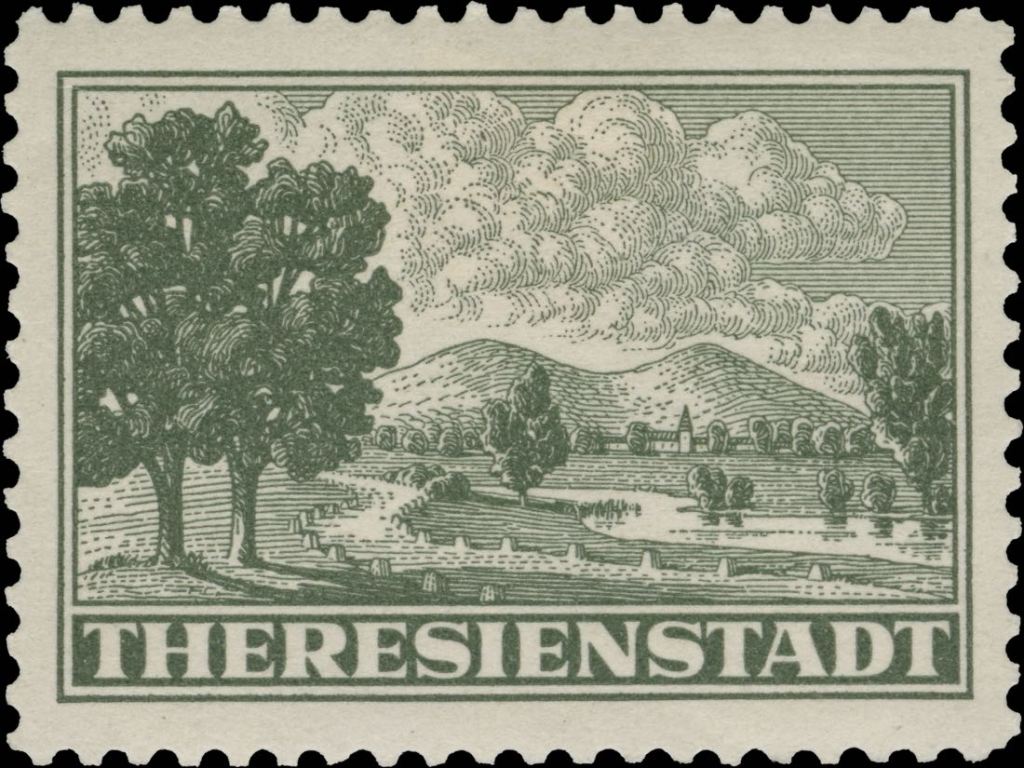
German Third Reich, 1943
Now look closely again. Even more closely. This is a complete forgery.
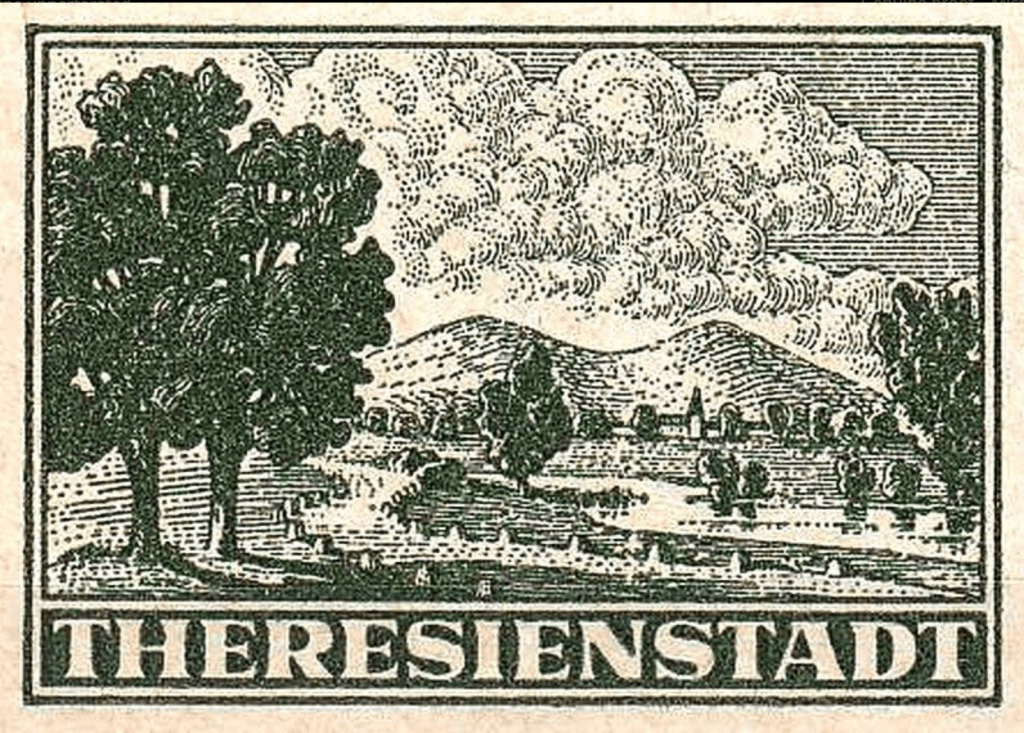
German Third Reich, 1943
The scene looks bucolic on both stamps. But it is not. It portrays a country scene located in the Protectorate of Böhmen und Mähren, 40 miles north of Prague, a Nazi sub-state creation carved from within Czechoslovakia by the Third Reich from 1941 to 1945.
But more specifically, the engraved pastoral image depicts Theresienstadt in 1943 where the infamous Nazi concentration camp of the same name was established in 1940. It was constructed on the same grounds first built in the late 17th. century by Austrian Emperor Joseph II, one of the last Holy Roman Empire Hapsburg emperors.
The camp was created to be both a labor camp and a transit-point for shipping Jews, Gypsies, Catholics, homosexuals. “politicals”, and “undesirables” to the killing factories located in German-occupied Poland, Belorussia, and the Baltic States. Although a transit point to the German murder factories, it was classified as a “ghetto” by the Nazis to the outside world. In the end, 140,000 human souls were transported through Theresienstadt. Of that number, 90,000 were transported to the murder factories at Auschwitz, Majdanek, and Treblinka. More than 33,000 perished there in place as slave labor.
You don’t see that in the stamp’s country village setting.
What made Theresienstadt different from other concentration camps was that it was explicitly used for Nazi propaganda and served as an obscene coverup. Although officially designated a ghetto, at times the regime claimed it was a “spa town” and transit point to Jewish “resettlement to the East”.
But it was not. That was the cover story for the concentration camp.
In reality, Jews were herded up into trains and trucks from cities like Riga, Warsaw, Lodz, Minsk, and Bialystock and sent to Theresienstadt. From there they were sent to the murder factories at Auschwitz, Majdanek, and Treblinka. Those not sent worked as slave labor and died of overwork, sickness, and starvation.
In 1943, the Nazis were under increased global pressure about the increasing global claims of genocide. In an elaborate hoax, they allowed the Red Cross to visit Theresienstadt in June 1944. To prepare for the visit, the Nazis “beautified” the ghetto planting gardens, painting houses, and renovating the concentration camp barracks, trying to make it appear as a worker’s paradise. Cultural events were staged and highly talented Jewish musicians gave performances for the visiting inspectors. Propaganda films were made for the visit. Once they had left, deportations resumed that following October.
Part of the coverup included developing a process by which the Theresienstadt victims could receive parcels from the outside as evidence of humane treatment. They would submit a “Parcel Admissions Request” card which was forwarded to the Jewish Council in Prague. The country and village scene was affixed and the faux request was sent along.

Zulassungmarke für ein Paket nach Theresienstadt, 14.8.44
The stamp attached to the card is singularly unremarkable. It portrays a picturesque landscape scene common throughout Europe at the time. As such it represents a part of the overall Final Solution coverup. But that is not what makes this stamp truly remarkable to this day.
The original horror of the hoax put over on the Red Cross inspections of 1944 was a part of the larger coverup of the Final Solution. To this day there are “Holocaust deniers” around the world. The rise of the extreme right worldwide includes this meme as part of its current narrative.
But what is just as shocking is that this stamp has repeatedly been forged and counterfeited at least 11 times, by some accounts, since it was originally printed. In fact, many of the forgeries are based on previous forgeries. They may be easily found in the philately marketplace today or on eBay and sell for between $80. to $150 US to the unsuspecting stamp collector. Most times they are not labeled as forgeries. Those not familiar with the role of Theresienstadt in the Final Solution may even buy a forged stamp, thinking they are buying a country scene of an area of Czechoslovakia during World War II.
The sellers of these stamps, in many cases, deny they are forgeries. At best they label them with obfuscatory language like “Cinderella” or “re-print” version of the stamp. When challenged, the defensive argument typically offered is “if you read the description I supplied, you will see I labeled it as such”. Indeed, some, when confronted with the facts of their stamp’s origins and probable forgery will outright deny it. Yet all sell this stamp in these price ranges.
Leaving aside the most obvious and obscene fact that these sellers are directly trafficking in forged stamps and profiting off the Shoah almost 80 years afterward, what is almost as bizarrely strange is that this stamp was forged at least 11 times according to forgery experts and is sold by so many today.
We know that we humans falsify major parts of our lives on a daily basis. We do cover up everything from telling socially emollient “small white lies” to murder and everything in between. In all these cases, we attempt to cover our tracks; to cover up our deeds. In the end, many of us carry coverups with us on an ongoing basis.
But only a few of us explicitly physically counterfeit things. Create actual objects and artifacts based on the same original.
The multiple forgeries of the Theresienstadt “Parcel Registration” stamp adds an additional layer of moral horror to the original purpose of the place. That stamp forgers would waste their technical execution talents on such an undertaking makes them complicit in the original coverup of the Theresienstadt.
These are peculiarly unique forgeries. Traditional forgers prefer to reproduce banknotes, paintings, rare documents, and objects for a variety of reasons, chief among them is pecuniary gain. But the history of forgery is also replete with counterfeiting examples where the skills exhibited by the forger exceed most artists. Upon closer inspection, indeed, their motives are revealed to be far more complex and personal than money.
Yet we have no explanation for why there have been multiple forgeries of this particular stamp and then sold for such a relatively small economic reward. That the backdrop of the Shoah hovers all of this makes understanding the motives of all the stamp’s various forgers all that more mysterious and compounds the horror of the original.
In the fullness of time, both coverups and forgeries are discovered and brought into full light. Human behavior though continues along much darker paths and only forged images represent that witness.
 burnesingman
Leave a comment